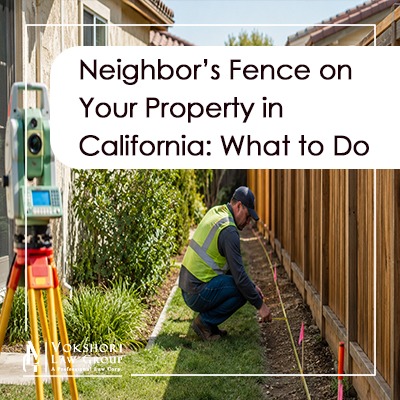
If your neighbor’s fence crosses onto your property, do not remove it before confirming the boundary and evaluating the legal risks. A fence usually does not control the legal property line, but long-term fence placement can create easement, adverse possession, or equitable hardship arguments. The practical question is not only whether the fence is over the line. It is what remedy a court would likely order.
The first move is usually a professional survey. Then review the deed, title report, legal description, recorded easements, and any prior written agreements. Until that review is complete, avoid admitting that the neighbor has permission to use the area, agreeing to a new boundary, or threatening self-help removal.
A Fence Does Not Usually Establish the Property Line
The legal property line is usually determined by recorded deeds, legal descriptions, subdivision maps, title records, and a professional land survey. A fence may be evidence of how owners historically treated the boundary, but it does not automatically change ownership.
That distinction matters. A homeowner may be right that the fence is misplaced, but wrong that removal is automatic. If the fence has existed for years, the neighbor may claim a right to keep using the disputed area, even if they do not own it.
California Civil Code Section 841 Applies to Boundary Fences, Not Every Encroachment
California Civil Code section 841 is often called California’s Good Neighbor Fence Law. It generally presumes that adjoining landowners equally benefit from a fence dividing their properties and are equally responsible for reasonable construction, maintenance, or replacement costs, unless they have agreed otherwise in writing.
But section 841 does not resolve every fence dispute. If the fence is actually on the boundary line, the issue may be cost-sharing. If the fence crosses onto one owner’s property, the issue may involve trespass, easement rights, adverse possession, quiet title, or removal. The survey determines which problem you are dealing with.
Long-term Fence Placement Can Create Easement Issues
If the fence has been in the wrong location for many years, the neighbor may argue that they have acquired a right to continue using the disputed area. That argument is usually framed as a prescriptive easement, equitable easement, implied agreement, or adverse possession.
A prescriptive easement is not ownership. It is a claimed right to use someone else’s property. Adverse possession is different because it seeks ownership of the disputed land. The distinction is important because adverse possession is harder to prove in California.
Adverse Possession is Hard to Prove in California
Under California Code of Civil Procedure section 325, adverse possession generally requires five years of possession and payment of the property taxes assessed against the disputed land. Long-term use alone is not enough.
That tax requirement is often a major obstacle in residential fence disputes. A small strip of land behind a fence is usually not separately assessed by the county. In Gilardi v. Hallam, the California Supreme Court rejected an adverse possession claim where the tax-payment requirement was not satisfied.
So if a neighbor says, “The fence has been there for years, so the land is mine,” that is not necessarily correct. They may still raise other arguments, but adverse possession requires more than time and use.
Removal is Not Always Automatic
Even if a survey confirms an encroachment, a court may consider whether removal is fair. California courts have applied the relative hardship doctrine in encroachment cases. In Hirshfield v. Schwartz, the court allowed an equitable easement where removing the encroachments would have caused hardship that outweighed the harm to the property owner.
But equitable relief is limited. In Shoen v. Zacarias, the court emphasized that an equitable easement is not automatic. The encroacher generally must show that the encroachment was innocent, that the property owner will not suffer irreparable harm, and that the hardship from removal is greatly disproportionate to the hardship to the owner.
In practical terms, a neighbor who knowingly builds on your land has a weaker equitable argument. A neighbor who innocently relied on an old fence line for many years may have a stronger argument, especially if the encroachment is minor and expensive to remove.
Practical Ways to Resolve the Dispute
The right solution depends on the survey, the history of the fence, the size of the encroachment, the neighbor’s position, and whether the issue affects a sale, refinance, remodel, setback, access, or property value.
Some disputes are resolved with a fence relocation agreement. Others require a license agreement, boundary line agreement, easement agreement, compensation, or a recorded settlement. If the neighbor refuses to cooperate or claims ownership, litigation may be necessary through a quiet title action, declaratory relief claim, trespass claim, injunction, or related real estate lawsuit.
The goal is not always immediate litigation. The goal is to protect title, prevent future claims, and choose a remedy that makes economic sense.
When to Speak with a Real Estate Attorney
Speak with a California real estate attorney before taking action if the survey shows a meaningful encroachment, the fence has existed for years, the neighbor claims ownership or easement rights, or the issue could affect a sale, refinance, remodel, access, parking, privacy, or development rights.
Boundary disputes are easy to mishandle. A casual email, verbal agreement, or delay in objecting can make the problem harder to resolve later.
Bottom Line
If your neighbor’s fence is on your property, start with evidence. Get the survey, review title records, preserve communications, and evaluate whether the neighbor has any easement, adverse possession, or equitable hardship argument. The fence may be over the line, but the remedy depends on the facts.
Frequently Asked Questions
Can I remove my neighbor’s fence if it is on my property?
Not without first confirming the boundary and evaluating the legal risk. A survey may show the fence is over the line, but that does not always mean immediate removal is the safest move. If the fence has been there for years, the neighbor may claim a prescriptive easement, equitable easement, or other right. Removing the fence without proper analysis can escalate the dispute and create liability.
Does a fence establish the property line in California?
Usually no. The legal property line is generally determined by deeds, legal descriptions, recorded maps, title records, and a professional survey. A fence may be evidence of how owners historically treated the boundary, but it does not automatically control ownership.
What if the fence has been there for many years?
Long-term fence placement can make the dispute more complicated. The neighbor may argue for a prescriptive easement, equitable easement, implied agreement, or adverse possession. Long-term use alone usually does not transfer ownership, but it may affect what remedy a court is willing to order.
Can my neighbor claim adverse possession?
Possibly, but adverse possession is hard to prove in California. Under Code of Civil Procedure section 325, the neighbor generally must show five years of possession and payment of property taxes assessed against the disputed land. In many residential fence disputes, the tax-payment requirement is a major obstacle because the disputed strip is not separately assessed.
What is California’s Good Neighbor Fence Law?
California Civil Code section 841 generally applies to fences on the boundary line between adjoining properties. It creates a presumption that both owners equally benefit from the fence and are equally responsible for reasonable construction, maintenance, or replacement costs, unless there is a written agreement saying otherwise. It does not automatically resolve an encroachment where the fence is actually over the property line.
Can a fence encroachment affect a sale or refinance?
Yes. A fence encroachment can raise title, escrow, buyer, lender, and disclosure issues. If a survey shows a boundary problem, it is better to address it before listing, refinancing, or starting construction.
Protecting Your Property Rights in California
If your neighbor’s fence is on your property in California, addressing the issue early can help prevent the dispute from becoming more complicated and expensive later. Boundary conflicts often involve more than a simple disagreement over measurements. Questions involving title rights, long-term use, easements, and property ownership can quickly turn a small encroachment into significant real estate litigation.
At Vokshori Law Group, our real estate attorneys represent California homeowners, investors, and property owners in complex real estate disputes involving fence encroachments, boundary conflicts, and easement issues. We work closely with clients to evaluate surveys, review title records, assess legal claims, and develop practical strategies tailored to the specific facts of the dispute.
If you are dealing with a fence encroachment or property line conflict, contact Vokshori Law Group today to discuss your situation with an experienced California real estate litigation attorney and protect your property rights before the dispute escalates further. Call us at (855) 855-2608 or visit www.VokLaw.com to learn more.